
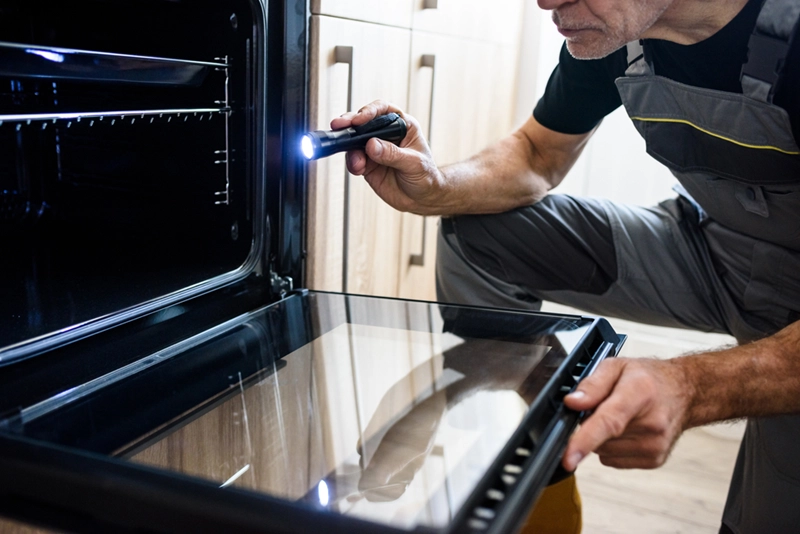
1. Safety first
Before you touch anything:
- Unplug the oven or switch off the circuit breaker.
- For gas ovens, close the gas shut-off valve.
- If you smell gas, do not try to light the oven. Ventilate the room and call gas emergency services and a technician.
If you are not confident working with electricity or gas, skip straight to the professional help section.
2. Quick checks before you assume a fault
Many “no heat” issues come from settings or usage, not a broken part.
- Check the mode and temperature
- Make sure the oven is actually in Bake or Convection Bake, not just Timer or Light.
- Confirm the temperature is set correctly and that you waited long enough for preheating.
- Verify the door is fully closed
- A door that does not close tightly can cause heat loss and long cooking times.
- Look for visible gaps, bent hinges, or something blocking the door.
- Test with an oven thermometer
- Place a simple oven thermometer inside.
- Preheat to a known temperature (for example, 180°C / 350°F).
- If the actual temperature is more than 15–20°C (25–35°F) off, there is likely a control or sensor issue.
If these simple checks don’t explain the problem, move on to the technical causes.
3. Common causes in electric ovens
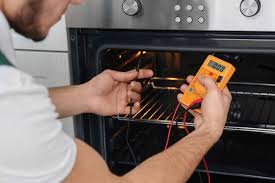
3.1. Faulty bake or broil heating element
Symptoms:
- Oven light and fan work, but there is little or no heat.
- The element has visible blisters, cracks or burn marks.
- Only the top or bottom of the oven gets hot.
What you can check:
- With the power OFF and the oven cool:
- Inspect the bottom bake element and top broil element.
- Look for breaks, rough spots, or areas that look burned.
- Turn the oven briefly to Bake and watch:
- A working element usually starts glowing red after a few minutes.
If the element does not glow or you see damage, it most likely needs replacement. This is usually a straightforward job for a technician.
3.2. Temperature sensor / thermostat issues
Symptoms:
- Oven reaches some heat but never gets hot enough.
- Food always takes much longer than recipes suggest.
- Big gap between set temperature and actual thermometer reading.
What you can check:
- Find the slim metal temperature sensor inside the oven (usually on the back wall or ceiling).
- Make sure it is not bent, touching the wall, or coated in heavy grease.
- Clean it gently if it is dirty.
If the sensor is physically damaged or tests out of range (requires a meter), it needs replacement and sometimes recalibration in the control board.
3.3. Control board or selector switch faults
Symptoms:
- Oven sometimes heats, sometimes not.
- Display works, but no heat in any mode.
- Error codes on the display.
Control boards and selector switches route power to elements. When they fail, the oven may stop heating completely or behave unpredictably.
What you can do:
- Perform a power reset:
- Turn off the breaker for 5–10 minutes, then turn it on again.
- If there is an error code, note it down for the technician.
Deeper diagnosis of boards and switches requires tools and experience, so this is usually not a DIY repair.
4. Common causes in gas ovens
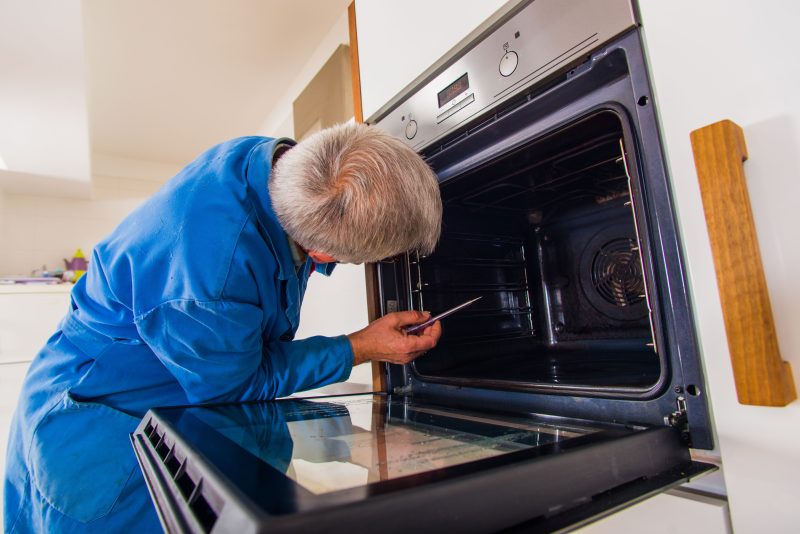
4.1. Igniter problems
Symptoms:
- You hear the oven trying to start, but it never lights.
- Igniter glows, but the burner does not light, or lights very slowly.
- Gas oven smells a little of gas during attempts to start.
What you can check:
- Look through the observation hole or bottom panel:
- When you set the oven to Bake, the igniter should glow or spark within a few seconds.
- If the igniter glows weakly or not at all, it may not draw enough current to open the gas valve.
Most igniter replacements should be done by a professional because of gas safety and the need to align the parts correctly.
4.2. Gas supply issues
Symptoms:
- Burners on the cooktop work, but the oven does not.
- Or, nothing gas-related works at all.
What you can check:
- Confirm the gas shut-off valve near the appliance is fully open.
- If your building had gas work or renovations recently, check whether the supply was turned off.
Do not attempt to adjust gas pressure or work on the gas line yourself. That belongs to certified technicians only.
5. Other reasons your oven may not heat properly
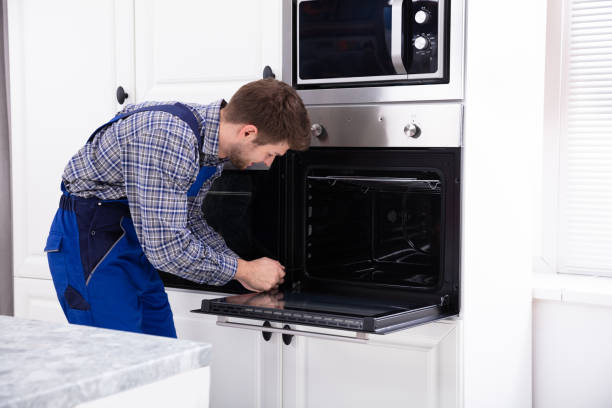
5.1. Damaged door seal (gasket)
A worn or broken door gasket allows hot air to escape.
Signs:
- You feel hot air escaping around the door while baking.
- The gasket has tears, flat spots, or missing sections.
Fix:
- Replacing the door seal is usually a simple job but requires the correct part for your model.
5.2. Overloading the oven or wrong cookware
Sometimes the oven is fine, but the usage is not.
- Overcrowding trays blocks air flow and leads to uneven heating.
- Very thick or dark pans can absorb heat differently and change cooking times.
- Foil covering racks or the bottom of the oven can disturb air circulation and temperature.
Try cooking with fewer trays, using standard light-colored bakeware, and avoid covering the racks with foil.
6. DIY vs professional repair: where to draw the line
Usually safe DIY checks:
- Verifying power at the outlet or breaker (without opening the oven body).
- Checking gas shut-off valve position (on/off only).
- Visual inspection of elements, sensor, and door seal.
- Cleaning the oven interior, fan cover, and sensor.
Call a technician for:
- Replacement of heating elements, igniters, gas valves.
- Work on control boards, wiring harnesses, or thermostats.
- Any gas smell, sparking, or signs of burning plastic.
Professional repair not only solves the current heating problem but can also prevent repeated failures caused by hidden issues like loose connections, partial shorts, or incorrect gas pressure.
For fast oven service in Brooklyn, schedule a visit through this page.